Gender Equality Day
August 26th every year is a red letter day in the annals of struggle by women for their rights. It represents the day when a century long struggle bore fruit as women suffrage was constitutionally approved in the United States in 1920. The victory is commemorated all over the world as Women Equality Day, in recognition of the unfinished legacy of this day, and the continuing struggle to achieve just treatment of women, and accord them their rights. However, today the equality discourse has co-opted men and transgenders too. Men have been carrying the burden of proving their ‘masculinity’ just as women are tamed to adhere to the norms of ‘femininity’.
Men have also been stigmatized for pursuing the ‘soft’ careers just as women have been thought a misfit in Science. If a man cries in public he is pansy. If a woman doesn't buckle down, she is masculine. Contemporary feminism seeks to dismantle these binaries. Very often gender equality is irrationally viewed as a feminist issue - a women issue. Gender discrimination cuts across all genders and concerns men and transgenders as much as it concerns women. Transgenders face the challenge to a dignified life. In some countries they are not even recognized as a third gender. Even if they are, they have to face the humiliation and live in inhuman conditions. In recently concluded general elections in Pakistan, transgenders were not allowed to enter the polling booths to vote. Likewise men are expected to adhere to rigid social norms just like women. They are scorned and sneered at if they opt for the so called feminine career like that of a nurse, beauty consultant etc., traditionally reserved for women. They have to live up to the enormous pressure to be a ‘real man’ and take on the role of the breadwinner for the family. They are expected to be emotionally resilient even in the face of adversity. However we know that historically men have enjoyed the privilege in personal and professional sphere simply by virtue of being men. The privileges that come with being a man have shielded them from a lot of struggles. Right to vote is one of them.
Suffrage movements in the West have a bitter history of struggle and resistance. Women who made an attempt to vote in the U.S. in the early 1870s were arrested and had to face lawsuits. Suffrage came relatively easy for their Eastern counterparts. One obvious reason was that in the early 20th century most of the Eastern countries like India, Sri Lanka were caught in the whirlwind of aggressive nationalistic movements for independence. With the end of colonial rule came the constitutional authorities that gave universal enfranchise to all citizens.
However, all over the world voting rights to women have proven to be just tokenism. It has not ensured any significant political participation of women in politics. In India out of 543 parliamentarians only 66 are women, amounting to barely 12%. In the US only 84 women are serving in the House of Representatives amounting to only 20% of the Congress.
These numbers are also symptomatic of the larger patriarchal attitude entrenched in societies all over the world, which reduce women to mere sexualized objects. Closer to home, in 2017 UP elections, a prominent BJP politician claimed that Priyanka Gandhi is not a star campaigner because there are more beautiful women in his own party. In other words, he was saying: What more could she offer! What else would a woman be good for?
Not only in politics, as recent as three decades ago women were conspicuous by their absence in literary histories, higher education, sports, the corporate sector, the armed forces etc. Thanks to the feminist movements in the 1970s, the contribution of women, hitherto invisible, in freedom movements, literature and other walks of life were finally brought to light. But there is a long way to go still. Women are still seen as irrational beings with lower intellectual capabilities as compared to men. These attitudes are apparent in common preference of couples keen on having a male child, or the all too pervasive casual jokes about women drivers. Not just ordinary mortals but also influential philosophers like Rousseau and Kant believed that woman are beautiful inferior beings and ‘not fit for serious employment’. If they are ‘beautiful and captivating’ that is enough.
Equality Vs Equity
Sexual violence, discrimination, illiteracy etc. are some of the prime reasons that hinder women from self-actualization be it political participation, climbing up the corporate ladder, or any conceivable field of existence and competition. One must pause here and ask what really is perpetuating these conditions. We have been paying lip service at the shrine of equality – laws have been passed, reservations are put in place, tax rebates are given, we even have a separate ministry here in India not to speak of the innumerable commissions. What has gone wrong then? It is time to go back to the drawing board and find the root of the rot. The first step to be taken must be an acknowledgment of the failure of the equality model. The equality model has not and cannot reverse the situation. Women should strive for equity rather than equality. Equality implies uniformity and sameness while equity means need based provisions. ‘One size fits all’ model to promote equality is insufficient.
Affirmative actions like reservation for women is not an ideal solution. Women have 33% reservation in the Panchayat elections in India yet women are still grossly underrepresented and marginalized. Very often they exist only on paper. It’s their husbands who take the decisions on their behalf.
To create an even playing field for women, we need to have programs, measures and strategies to make up for the historical and social advantages women face in the workforce and in their personal life.
To achieve gender equity, we need to recognize that the traditional social roles, rights and responsibilities of men and women need to be redefined. Giving maternity leave to both men and women, for example, will not solve the problem unless men are sensitized that they too need to contribute to childcare. Equality model does not work unless equity is in place. If equality is the end goal, equity is the means to get there.
The status of women has changed for the better in the last few decades. But there are some pressing issues like unequal pay for equal work, domestic and sexual violence, inhuman working conditions of women in unorganized sector etc. which need to be addressed. Even a sport as glamorous as tennis suffers from gender pay gap. A major cultural revolution needs to accompany policy change to stop relegating women to a subservient and inferior position as compared to men.
This Gender Equality Day let’s strive for a world where labels like feminism are rendered meaningless and merit prevails over gender and equality between all genders becomes a given.
The author of this article, Richa Singh is a content writer with Investronaut. She is a voracious reader and a keen traveller.

Trade is the single most important factor that has shaped the destiny of the modern world. Cultures and goods freely crossed the silk route for centuries bridging the gap between East and West. Modern nation-states were founded upon the premise of protectionism and expansion of trade during Renaissance, and funded by finances generated from trade. The importance of trade dates back to pre-industrial and pre - nation societies. Much of our history comes from travelogues drawn by traders who traveled through the world, drawing maps and our concept of the world. It is no exaggeration, therefore, to suggest that trade is one great unifier that has fueled the establishment of a civilized world as well as modernity on its own.
Free trade Vs Protectionism
Free trade is the policy of treating foreign goods and services no different from domestic goods and services and allowing producers from overseas to freely sell their goods in the country.
Protectionism is a policy of discriminating against foreign goods and services and restricting trade by imposing tariffs on them, thereby making them costlier for the customers.
At different times in history, protectionism and free trade have dominated the trade patterns. However, most agree that free trade is the means to promote peace and economic prosperity amongst countries.
Peace through trade?
It is an established fact that free trade benefits nations by increasing their wealth and living standards. India’s own story post-liberalization is testimony to that. Countries that trade a lot with each other are less likely to go to war with each other because free trade makes countries more commercially inter-dependent giving them the economic incentive to keep hostilities at bay. India and Russia share outstanding bilateral ties. Russia has been supporting India on various international forums and vice versa. The reason is the high trade link between the two countries. India is the second largest buyer of defence equipment from Russia. It reflects in the perception Russians have for India. A good 45% of Russians view India positively and only 9% expressed negative views, according to a BBC World Service Poll conducted in 2014.
Traders or businessmen influence the government. If they are doing profitable business with other countries, businessmen on both the sides will be opposed to war. Recently China has reduced the import duty on American cars by 10% opening huge possibilities for American car makers in China. US has also blinked on its decision to slap import duty on Chinese goods to the US. It has bought truce to the two countries otherwise on the verge of trade war.
India and Pakistan share dismal bilateral trade figures which reflect in the volatile relations the two two countries share. Every time the conflict with Pakistan hits a new bottom, experts suggest that the only way to normalize the situation is to improve mutually beneficial trade ties. On several occasion when politics has failed us, trade has come to the rescue. After the Uri attack where 18 Indian soldiers were martyred, India retaliated and hostilities on both sides reached a new high. India banned Pakistani artists from working in India. Pakistan countered it by banning the Indian movies. However, within a few months Pakistani cinema owners incurred heavy losses and amidst heavy pressure, the decision was revoked. Practical considerations of money sometimes force peace and keep the hollow noises of nationalism in check!
Extensive trade links may not always be directly proportional to good diplomatic relations. Despite Indian markets being flooded with Chinese goods and a whopping bilateral trade volume of US$ 84.5 billion between the two countries, the diplomatic relations with China are not always cordial. Yet, the importance of trade in normalizing relations does not diminish. Trade does not occur in a vacuum. Trade accompanies cultural exchanges and exchange of ideas. Trade breaks the wall of mystery and stereotypes and humanizes the people one trades with. It makes the people on the other side of the border seem less demonic, making us realize that people all over are the same with same hopes, sorrows and joys. It makes us more tolerant and understanding of each other’s differences and makes the countries look more than mere lines on the map.
That is why despite the border disputes with China and Pakistan which could completely cripple the bilateral ties, trade helps to maintain some semblance of normalcy. Indian movies make mighty sums of money in China and Pakistan and Indian movie stars are widely revered there, resulting in cultural closeness. The legends of humungous popularity of twinkling blue eyed Raj Kapoor singing..... mera joti….mera joti hai japani..Sar pe lal topi rusi…. are still talked about in India and Russia. Such cultural exchanges facilitated by trade keep the tensions lower if not completely mitigate them.
Protectionism on the other hand, leads to ill feelings towards other nations.
In the 1930s, industrial nations increased trade barriers leading to spitefulness amongst countries, setting the stage for World War II.
Protectionist sentiments are stirring all over the world evident in Brexit and the ‘Make in India’ initiative in India. India has raised import tariffs to the highest in the last three decades leaving all its important trade allies including the U.S, up in arms. The U.S is already mulling over doing the same to Indian goods.
Trump’s “America- First” policy has had its repercussions on India’s important information technology industry – which generates output worth $150 billion per year.
These seemingly harmless retaliations proves to be an ammunition for the war.
French economist, Fredric Bastiat famously wrote- If goods don’t cross borders, armies will. I would humbly agree to it!
References-
https://en.wikipedia.org/wiki/India%E2%80%93Russia_relations
https://fee.org/articles/want-peace-promote-free-trade/
The author of this article, Richa Singh is a content writer with Investronaut. She is a voracious reader and a keen traveller.

The #metoo campaign following the stories of women assaulted by Harvey Weinstein restate the ubiquitous sexual harassment of women at Workplace. It is not the first instance of abuse of power by the people in important positions. The infamous Tarun Tejpal case back in India is yet another glaring example of the all pervasive problem of harassment of women. In many instances women are unaware of the complaint mechanism and existence of law against sexual harassment at the workplace.
Indian women have been in the work force since the 1950s, the number multiplied multifold post liberalization in the 1990s. Yet, sexual harassment didn't hit the Indian legal map until 1997. In 1992, Bhawri Devi, a village level Rajasthan government employee was gang-rapped by the village landlords after she tried to stop a child marriage in their family. The case led to the filing of the Public Interest Litigation (PIL) by a women’s rights group- Vishakha, after which the Supreme court laid down guidelines, also called as Vishakha guidelines to be followed at the workplace.
Sexual Harassment of Women at Workplace (Prevention, Prohibition and Redressal) Act came into force in 2013. Sexual harassment is punishable under section 354 of the Indian Penal Code. The convict can face one to three year imprisonment and/or fine.
What constitutes sexual harassment at workplace?
Sexual harassment is making unwanted sexual advances , obscene remarks, showing sexually offensive visuals and demands for sexual favors. Inappropriate texts, unwelcome social invitations, lewd comments making sexually colored jokes, innuendoes, staring, intimidating women or any other behavior that makes a woman uncomfortable constitutes sexual harassment.
Execution of Sexual Harassment Act at workplace
The sexual harassment act requires all companies with more than 10 employees to set up an internal complaints committee, with one external member, headed by a woman. It is meant to encourage women to lodge their complain in a fear free environment and ensure a transparent system of redressal. But the reality is far from hopeful. Non-compliance of the act is rampant in companies.
According to the 2016 report on sexual harassment by Indian national Bar Association, despite the provisionsthere is no complain committee at most organization and they have no knowledge of the process.
Women find it overwhelming to challenge the employers or male colleagues for the fear of termination from their job, retaliation, lack of confidence in the organization , low awareness about laws and procedures and fear of embarrassment and stigma.
Most organizations tend to push these cases under the carpet for they view it as a blot on their public image and not as a breach of an individual woman’s right to safety and dignity. There is a sense of denial in that organizations believe that sexual harassment is something that happens in other organizations and does not exist in their own because there are no reported cases. Organizations even evade calling the term sexual harassment, such cases are often labelled as ‘inappropriate behavior’ and ‘internal matter’. Companies tend to dismiss this issue as unimportant and hope it will be forgotten in the due course. Or, the HR department will be equipped to handle it and the employees rules of conduct will be adequate to handle the situation should the need arise. Companies fail to recognize that sexual harassment is a socio-legal issue and HR department is not enough to tackle the specifics of the issue.
In response to the #Metoo campaign, Women and Child Development Ministry has launched an online portal called as the ‘SHe-box’ to report sexual harassment at workplace.
How can men contribute?
Gruesome sexual violence on the rise against women and right-wing groups validating them should be a cause of worry for all of us. Men can be powerful allies too in sexual assault prevention.
As men you need to understand that passing comments, staring, making unwanted phone calls, whistling or any other activity that is making a woman uncomfortable needs to stop now. Don't encourage or participate in such behavior.
Take down your Bollywood tinted glasses which tell you that when a girl says no she actually means yes. That’s nonsense! No means no. Understand the concept of consent.
Do not respond to sexist jokes and question people who do. It will make them think. Refrain from using gender based abusive words and language that objectifies women.
Remember that only the person perpetrating sexual violence is responsible for it. Whether a woman was wearing short dress or not, whether she was drunk or not, the time she went out and what company she was in is irrelevant. Do not blame and shame the victim.
Men need to interrogate their own privileges and the traditional notions of masculinity and femininity that put women in a hierarchical subservient position. They have to understand that gender equity is an important facet to violence prevention. Legal framework can hardly yield success until there is enough sensitization about the issue at the workplace and the cultural practices which allow men to feel superior to women are quashed.
References-
Sarpotdar, Anagha, “Sexual harassment of Women, Reflections on the Private Sector”, Economic and Political Weekly of India, Vol XLVIII No 40, October 5, 2013.
https://www.indianbarassociation.org/wp-content/uploads/2017/07/Garima-1INBAs-Book.pdf
The author of this article, Richa Singh is a content writer with Investronaut. She is a voracious reader and a keen traveller.

The International Day for Universal Access to Information is celebrated each year on 28th September. The term ‘Information’ has important connotations and consequences for the modern world beyond the cursory “acts provided or learned about something or someone” as mandated by the dictionary. The extent, content, and nature of this ‘learned’ information as well as the objective and the audience of this learning, are fundamental to defining the political orders and models of governance that are conceived, and adopted by any state.
This is particularly true of states like India that are conceived as democracies, where the will and choice of the voting public reign supreme. In such a scenario, it is absolutely essential that the people who vote have clarity in their choice of elected representatives, which necessarily involves an unqualified and unrestricted access to information on ‘polity’ and ‘policy’.
Access to Information as a safeguard of Democracy
Public access to information is one of the keys to a thriving democracy. For a democracy to flourish, its public institutions should be free of corruption. In most developing countries, development projects are marred by high levels of corruption. The funds meant for infrastructure, education, health, and housing are diverted to the deep pockets of politicians, middlemen, and contractors. It perpetuates the cycle of poverty and injustice, undermines the rule of law and weakens confidence citizen have in democratic institutions. Corruption thrives due to the lack of transparency and back door deals. With access to information, governments can be held accountable and questioned for their policies and expenditure on health care, education and other public services. Access to information increases public participation in governance by allowing the citizens to scrutinize the actions of the government and encourage a well-informed debate on matters of policy and national importance. A debate, as we know, is the backbone of a healthy democracy.
Right to Information and the death of RTI activists.
In 2005 India joined the illustrious list of countries passing laws for open access to information when the Right to Information Act (RTI) came into force. Under the provision of this Act, any citizen of India can request information from a public authority or office. The concerned office has to reply within 30 days. The Act gives citizens access to information to which hitherto only government officials were privy to, making every citizen a potential whistle-blower. Unfortunately, the Act that was meant to bring transparency in the system has ruffled many feathers.
Tragically, since 2005, more than 60 people have been murdered and numerous others tortured for exposing the corruption in the government on the basis of the information they received under the RTI Act. Nanjibhai Sondarva of Manekvada village in Gujarat is the latest to pay the price for seeking information under RTI. He was murdered by six people in March 2018 for seeking information about the funds spent on the construction of a road in his village. Try a google search on attacks on RTI activists in India and you will be taken aback to find a never-ending list of people who have been murdered, kidnaped, tortured, harassed, assaulted and driven to suicide.
This despite the 2014 Whistle Blowers Protection Act which promises to protect the person who exposes corruption in the government bodies, offices, and projects.
India has been ranked a dismal 81st in Corruption Perception Index 2017 by Transparency International. India has also been characterized as the worst “regional offenders” in Asia Pacific region on grounds of murders of journalists, activists, opposition leaders and intimidation and threatening of investigating agencies. As the statics indicate RTI Act alone can’t combat corruption until a sincere political will to weed out corruption prevails. In the current scenario when crackdowns on activists, journalists and civil society, in general, are on a rise, isn’t it all-important to protect a few who dare to speak up and question the establishment?
The author of this article, Richa Singh is a content writer with Investronaut. She is a voracious reader and a keen traveller.

Learning a language is hard enough, learning a foreign language harder. A language is not simply an assortment of names and sounds, but an ever expanding catalogue of a culture. Learning a new language means experiencing a culture that is not only absent but also fundamentally different from the one in which one has grown. This cultural immersion is one of the most difficult things as the biases of own cultural conditioning continuously exert a pull that resists the foreign influences. The experience can be immensely frustrating. Yet, where there is a will there is a way as the old adage testifies. If you persist long enough, the process of learning a foreign language can be immensely enriching.
The benefits of learning a foreign language far outshine the clichéd and done to death adding sheen to your CV. How does it benefit thee, let me count the ways! For one, it is an excellent brain exercise and has documented health benefits. Learning a new language is fun and is proved to boost our cognitive process, helps in better memory and delays dementia and Alzheimer’s. Learning a new language makes us a good listener as we have to pay attention to gauge the meaning in a new language. It allows us a sneak peek into a new culture. Learning new languages is not just a tool to explore the world outside, it takes us on an interesting journey inwards to understand the self. You emerge a more cosmopolitan and enriched person, an invaluable advantage in a globalized world.
The limits of your language are the limits of your world. Learning a language opens a whole new way of life to us because language acquisition cannot take place in isolation. Language and culture are deeply intertwined. Teaching-learning a foreign language is assisted by watching movies, learning songs, reading books etc. This exposure to new culture infuses cultural tolerance and brings an inevitable comparison to our native culture allowing us to self-reflect and understand our own position in the world. We might find an unexpected connect in another countries -music, food, dance etc that were hitherto alien to us.
You might claim that all this is fine but does it offer any tangible career benefits? Why should you as a student enroll for a language course? To put your brains where the money is, you can make a successful career out of it too, while having a great time.
Translator
In the age of instant google translator, the career as a translator is still a sought after one. It allows you the flexibility to work from any corner of the world as long as you have an internet connection. Since it is well paying and much in demand, it is highly competitive. One is advised to specialize in a niche domain such as education, law, medicine, science etc.
Interpreter
Interpreters are in demand in courtrooms, conferences, parliaments of multilingual countries, UN etc. Interpreters during live interviews and speeches are much in demand. Along with the message a good interpreter should also convey the personality of the person for whom you are interpreting so that the interpreters own personality stays in the background.
Flight Attendant
Foreign languages can open your path to one of the most glamorous professions and a ticket to travel the world. A combination of English and a foreign language like French, Spanish or German could be your ticket to an exciting career as a flight attendant.
Embassies and Consulates
Each country has an embassy and consulates that provides diplomatic services to other countries. These embassies and consulates need people who speak the local language.
These jobs are very prestigious and applicants with a very high proficiency are recruited after a rigorous selection process.
Proof reader/ Editor
Anything that is written/ translated needs to pass the watchful eyes of a proofreader before it is published. As a proof reader your role will be to find and correct any grammatical error in the document. A lot of international companies are setting up businesses in India. They hire people for translation and proof reading of their documents for formal communication.
Hospitality, Tourism and Travel Tour guide
With a degree in a foreign language, you can expect to work with museums and monuments as a multilingual tour guide. If you love to meet and chat with new people, this could be an option worth considering.
Trainer/ Teacher
Companies with businesses overseas train their staff in the local language before sending then abroad onsite. One can work as a corporate trainer for these companies and carry home a hefty pay check.
There are ample opportunities for qualified teachers in foreign languages. Most schools offer German, Russian, French or Russian, Japanese etc as a third language. Most universities too have foreign language departments.
Higher education in Europe
Germany, Finland and many other European countries do not charge tuition fees for higher education and countries like German and France offer generous scholarships for a Masters and Doctoral courses. A degree/diploma in foreign language opens research and higher studies opportunities abroad.
There is a world beyond engineering, medicine and management which is equally rewarding and perhaps more exciting. Don't be scared to explore it. There are no promises that it’s going to be an easy ride. The rat race and competition is a part of every profession, one can’t help it. But to be in a race one enjoys makes it worthwhile.
The author of this article, Richa Singh is a content writer with Investronaut. She is a voracious reader and a keen traveller.
Vishwakarma University conducted a B.Arch Course in Pune. Bachelor of Architecture is a COA (Council of Architecture) approved five-year undergraduate degree programme designed to provide students. Admissions open for 2021-2022.
Diploma in Pharmacy (D.Pharm.) is the minimum qualification required to be a registered Pharmacist in India. With an outcome-focused curriculum, this programme is designed for students to gain the necessary skills and grasp academic excellence for entry-level positions in retail pharmacies, hospital pharmacies as well as pharmaceutical companies.
A career in psychology requires an in-depth study of how people and/or groups think and feel. The observance of human behaviours, how they think, how they feel, and in the majority of cases, why they think and feel the way they do, is the goal of someone in the field of psychology.
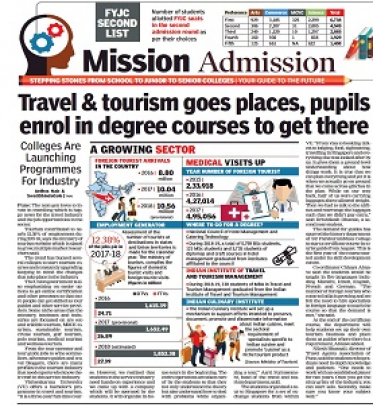
Tourism has become a major economic activity in the world and one of the fastest-growing industries which demands a professional outlook.
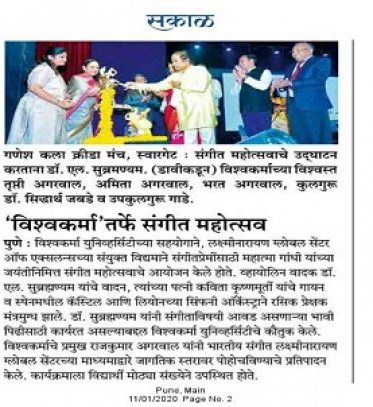
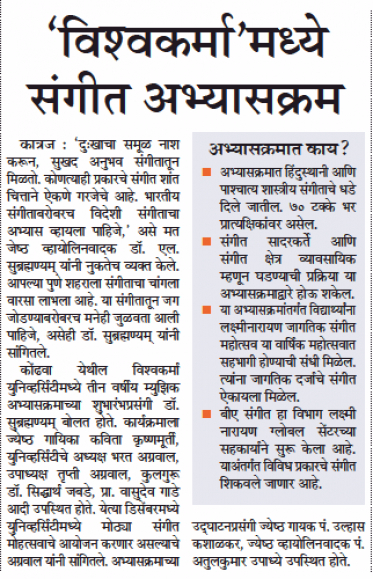
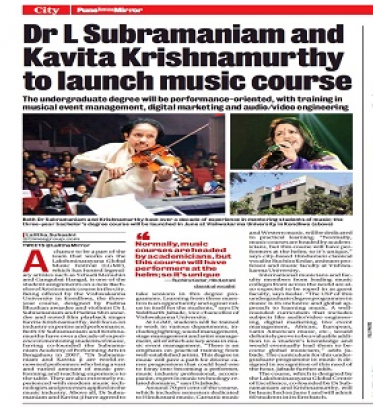
This BA (Hons) in Music Programme in association with the Lakshminarayana Global Centre of Excellence is a 3-year unique course that prepares students with qualifications that are globally recognised and industry-relevant skill sets.
The M.A. in Journalism and Mass Communication programme empowers students to shape a trailblazing career in the field of news, media and entertainment. MAJMC is a two years full-time postgraduate programme that encompasses the world of advertising, TV production and Journalism.
The bachelor’s in Journalism and Mass Communication is a four year comprehensive degree designed according to New Educational Policy (NEP) to bring out new age media professionals with the highest emotional quotient. The ever-expanding verticals of the creative and service industry are offering a sea of opportunities to students in the news industry, political communication, public engagement, communication research and digital content industry.
LL.B. is a three years undergraduate degree programme in Law enabling the students to get requisite knowledge of basic laws, both substantive and procedural laws, to be skilled legal professionals.