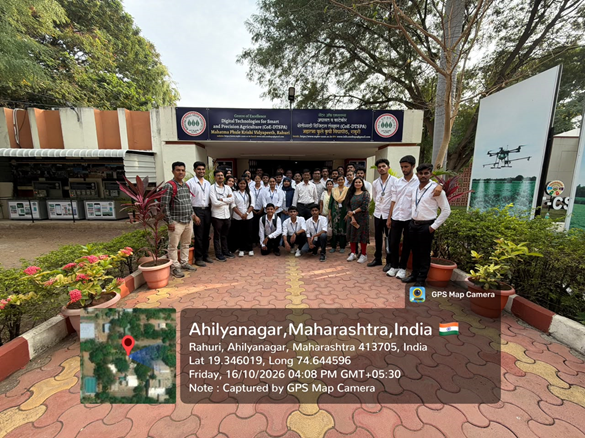
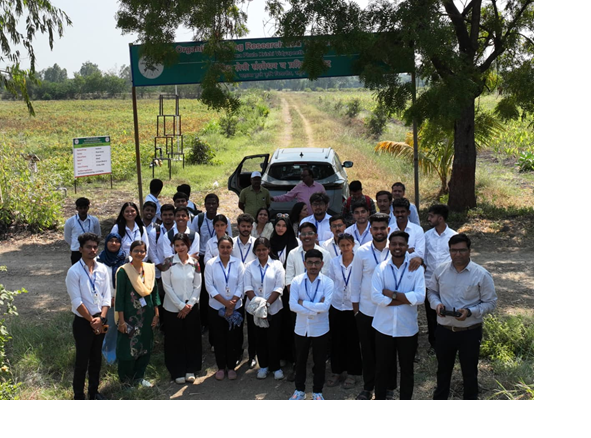
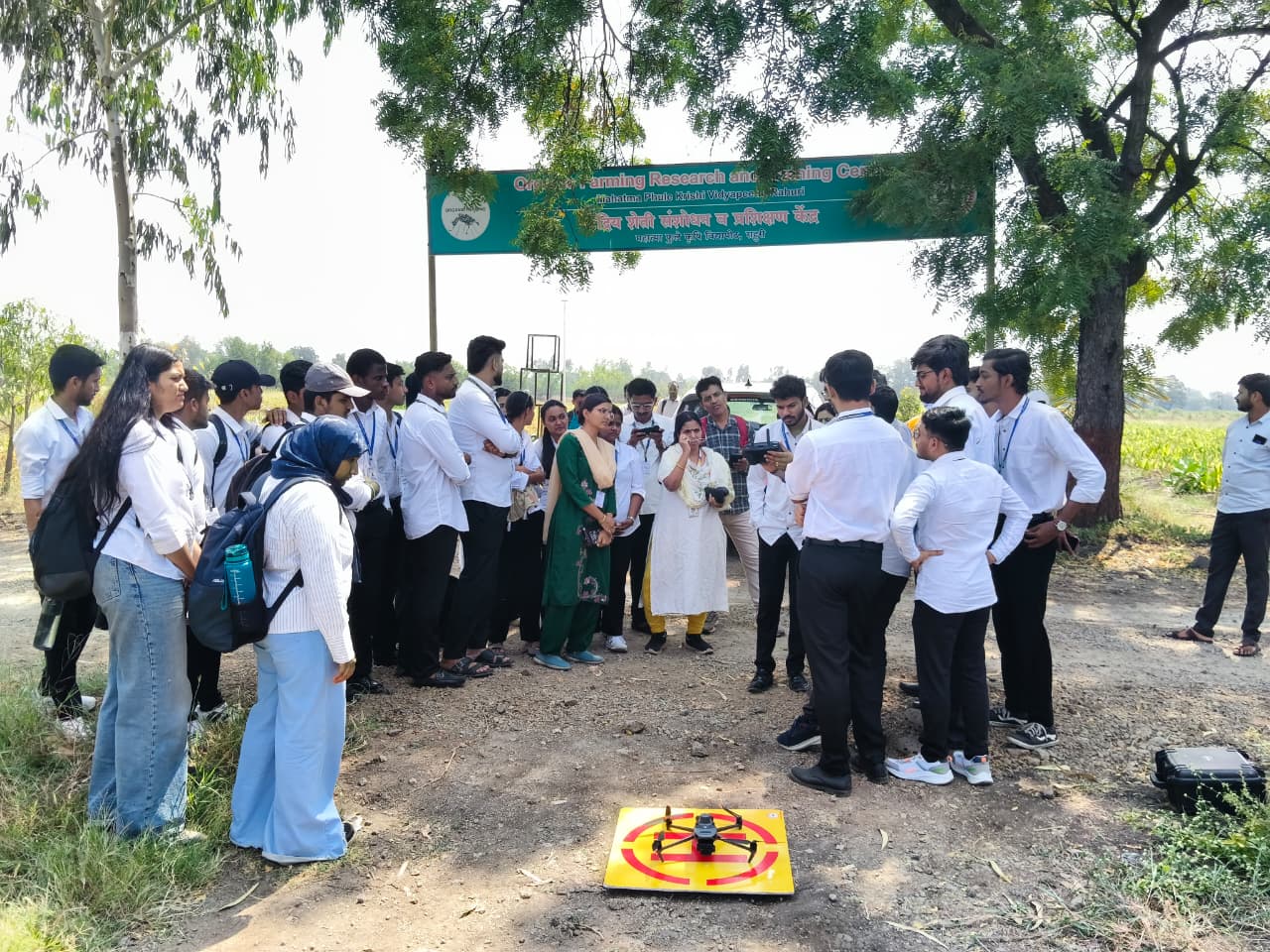
The Department of Computer Science, Vishwakarma University, Pune, organized an industrial visit to the Centre of Excellence – Digital Technologies for Smart Precision Agriculture (CoE-DTSPA) at Mahatma Phule Krishi Vidyapeeth (MPKV), Rahuri, Maharashtra, on Friday, 16 October 2026.
The visit aimed to provide students, PhD scholars and faculty members with practical exposure to the application of emerging technologies in agriculture. The visit offered an opportunity to understand how Artificial Intelligence (AI), the Internet of Things (IoT), robotics, drones, remote sensing, and advanced imaging technologies contribute to smart and precision agriculture and understand the role of Computer Science in modern agricultural practices and explore opportunities for interdisciplinary projects, innovation, and collaborative research.
The visit included exposure to laboratories and research facilities at CoE-DTSPA, MPKV, Rahuri. The participants visited the Drones in Agriculture Laboratory, Robotics in Agriculture Laboratory, Hyperspectral and Multispectral Imaging Laboratory, Remote Sensing and Geographic Information Systems (GIS) Laboratory, and IoT and Sensors Laboratory. They also visited the Climate-Smart Research and Development Block and IoT Demonstration Park to understand the practical applications.
Dr. Madhuri Pant has arranged the visit and Prof Suhas Chavan and Prof. Shriprada Chaturbhuj accompanied the visit
.jpeg)
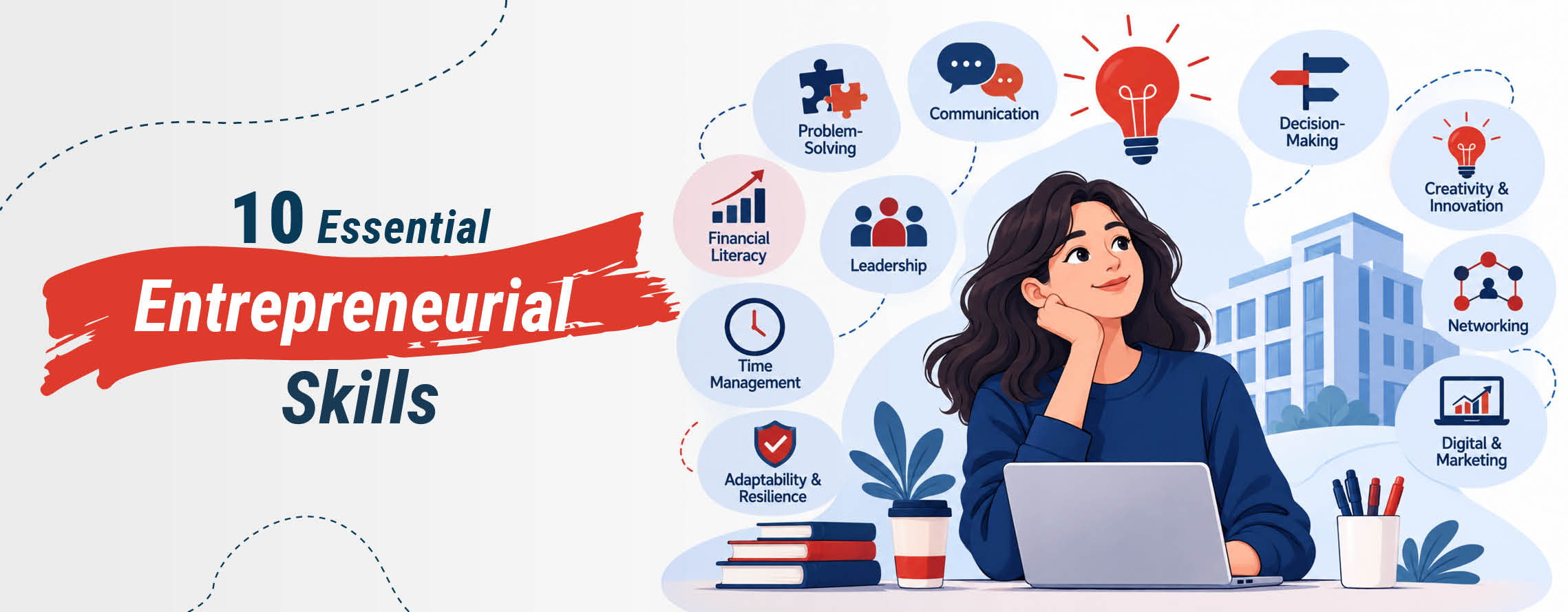
Entrepreneurial skills help students transform ideas into opportunities, problem solve and make informed decisions. Even if you are not looking to start your own business, these skills are still very useful. You can develop these skills whilst at college using projects, team work and hands on experiences. At Vishwakarma University, you can also get involved in innovation and entrepreneurship initiatives to get an understanding of how ideas can be developed into real world solutions.
| Title | AI Day:AI Games Arena with Hackathon 2026 |
| Workshop Dates | 12th August 2026 |
| Venue | Competitions: 2nd Building, 1st Floor — Classrooms 2101, 2102, 2103, 2114, 2115 |
| Convener | Prof. (Dr.) Kailas R. Patil, Dean - Faculty of Science & Technology, Vishwakarma University, Pune Dr. Pavitha Nooji, Associate Dean - Faculty of Science & Technology, Vishwakarma University, Pune |
| Co-Convenor | Prof. Prajakta Dhamdhere, Head - Department of Artificial Intelligence, Faculty of Science & Technology, Vishwakarma University, Pune |
| Faculty Coordinators | Dr. Pratibha Mahajan - Department of Artificial Intelligence Dr. Nilufar Zaman - Department of Artificial Intelligence Prof. Ashwini Sengar - Department of Artificial Intelligence Prof. Vishakha Salunkhe - Department of Artificial Intelligence |
Objective:
The objective of AI Day was to provide students with an engaging, hands-on platform to explore Artificial Intelligence concepts beyond the classroom. The event was designed to test three core skills — prompt engineering, AI literacy, and rapid creative ideathon — through structured games, while also giving students exposure to a live guest session by an industry expert. The event aimed to make AI accessible, exciting, and competitive for students across all branches. Alongside AI Day, a dedicated Hackathon was organized for Last Year (LY) students on 12th August 2026. The event ran from 10:30 AM to 3:00 PM and was held across two venues — the SAP Lab (Room 2101) and Room 2113. The hackathon was conducted in two rounds. In the first round, all registered teams participated and presented their solutions to a problem statement provided by the college. Based on evaluation, five teams were shortlisted for the final round. In the final round, the five teams competed head-to-head and one winning team was selected by the judges. The winning team was awarded and felicitated at the end of the event.
Program Highlights:
Guest Session
The event began with a Guest Session from 10:30 AM to 12:30 PM. Students from Second and Third Year attended the session, which covered real-world applications of Artificial Intelligence and perspectives from industry. The session was held across classrooms 2102, 2103, 2114, and 2115 on the 1st floor of the 2nd building, and was attended by a large number of students.
AI Games Arena
Following the Guest Session, the AI Games Arena was conducted. The arena consisted of three games, each running for approximately one hour. All three games followed an elimination-based round format — participants competed in multiple rounds within the one-hour window, with a set number qualifying into each subsequent round, until a final winner was determined per game. One Overall AI Champion was announced at the end of all three games, based on cumulative performance.
Game 1 — Prompt Golf & Jailbreak Challenge
Participants were shown a target output on screen and had to craft the shortest, cleverest prompt to make an AI model produce that exact output. Each round had a fixed timer. Prompts were judged on accuracy, length, and creativity. Multiple rounds were conducted, with top performers advancing each time.
Scoring breakdown:
Game 2 — AI vs Human: Spot the Bot
A fast-paced quiz where participants were shown a series of samples — images, text passages, or code snippets — and had to identify whether the content was AI-generated or human-made. Participants voted live using a hands-up format (left hand for AI, right hand for Human). This game also included a Code Debugging Challenge segment, where buggy code was displayed on screen and participants had to identify the errors as quickly as possible. The game used a sudden-death format in the final rounds.
Game 3 — Crazy Pitch Arena
Participants were grouped into small teams on the spot, each given a card with three random constraints (such as target audience, technology type, and a limitation). Teams had 30–35 minutes to design a rough AI product concept — sketches or slides, no coding required. A gallery walk was then conducted for judge review, after which the top teams presented a two-minute live pitch on stage. Individual winners were identified based on pitching strength and idea contribution.
Scoring breakdown:
LY Student Hackathon
The hackathon was conducted in two rounds. In the first round, all registered teams participated and presented their solutions to a problem statement provided by the college. Based on evaluation, five teams were shortlisted for the final round. In the final round, the five teams competed head-to-head and one winning team was selected by the judges. The winning team was awarded and felicitated at the end of the event.
Hackathon at a Glance:
Volunteer & Club Member Contribution
The event was made possible through the collective effort of NextGen AI Club members and volunteers. Club members were present from 8:30 AM onwards, managing classroom arrangements, participant flow, game coordination, scoring, and audience engagement across all four classrooms simultaneously. Volunteers were assigned to 3–4 classrooms with 4–5 members per classroom. Each volunteer was recognized for their contribution and will receive a participation certificate for the event.
Learnings & Impact
The event gave students a firsthand experience of how AI models respond to different kinds of prompting, exposed them to the nuances of AI-generated versus human-generated content, and challenged them to think fast and creatively under constraints. The Code Debugging segment in particular helped bridge the gap between theoretical AI awareness and practical programming skills. The Crazy Pitch Arena encouraged lateral thinking and rapid problem-solving — skills directly relevant to the AI industry.
Conclusion
AI Day was successfully conducted on 12th August 2026 and received strong participation from students across Second and Third Year. The event brought together a Guest Session and three competitive games under one roof, making it one of the larger events organized by the NextGen AI Club of Department of Artificial Intelligence of this academic year. The club looks forward to building on this experience and organizing further events that make AI education more engaging and accessible for students at Vishwakarma University.
.png)
.jpeg)
Name of activity: Tree Plantation Drive
Date of activity: 23 rd August 2026
Venue: TFRF, Diveghat, Pune
Coordinators: Prof. Yogita Shinde, Prof. Archana Shaha & Dr. Dipali Talele
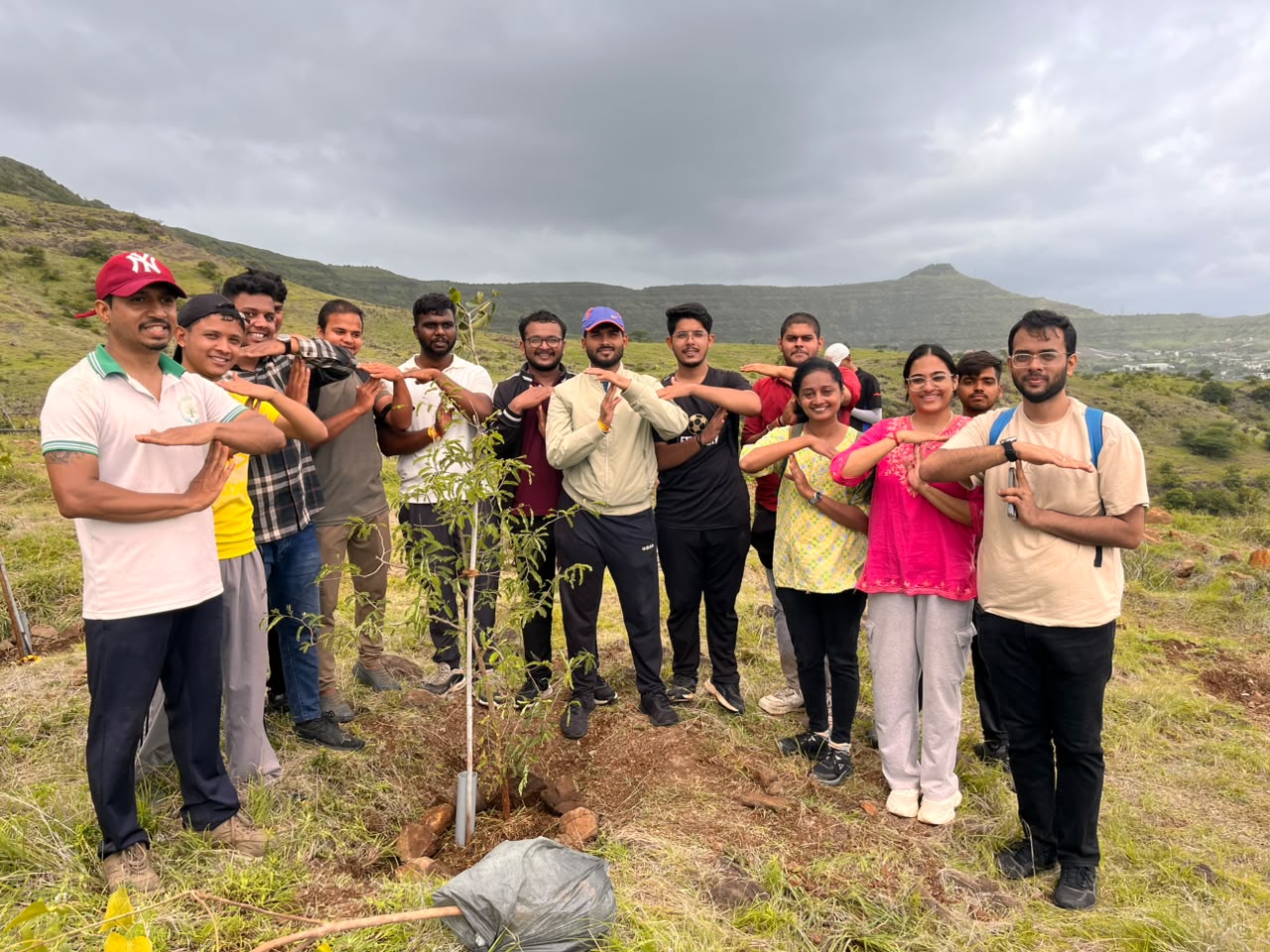
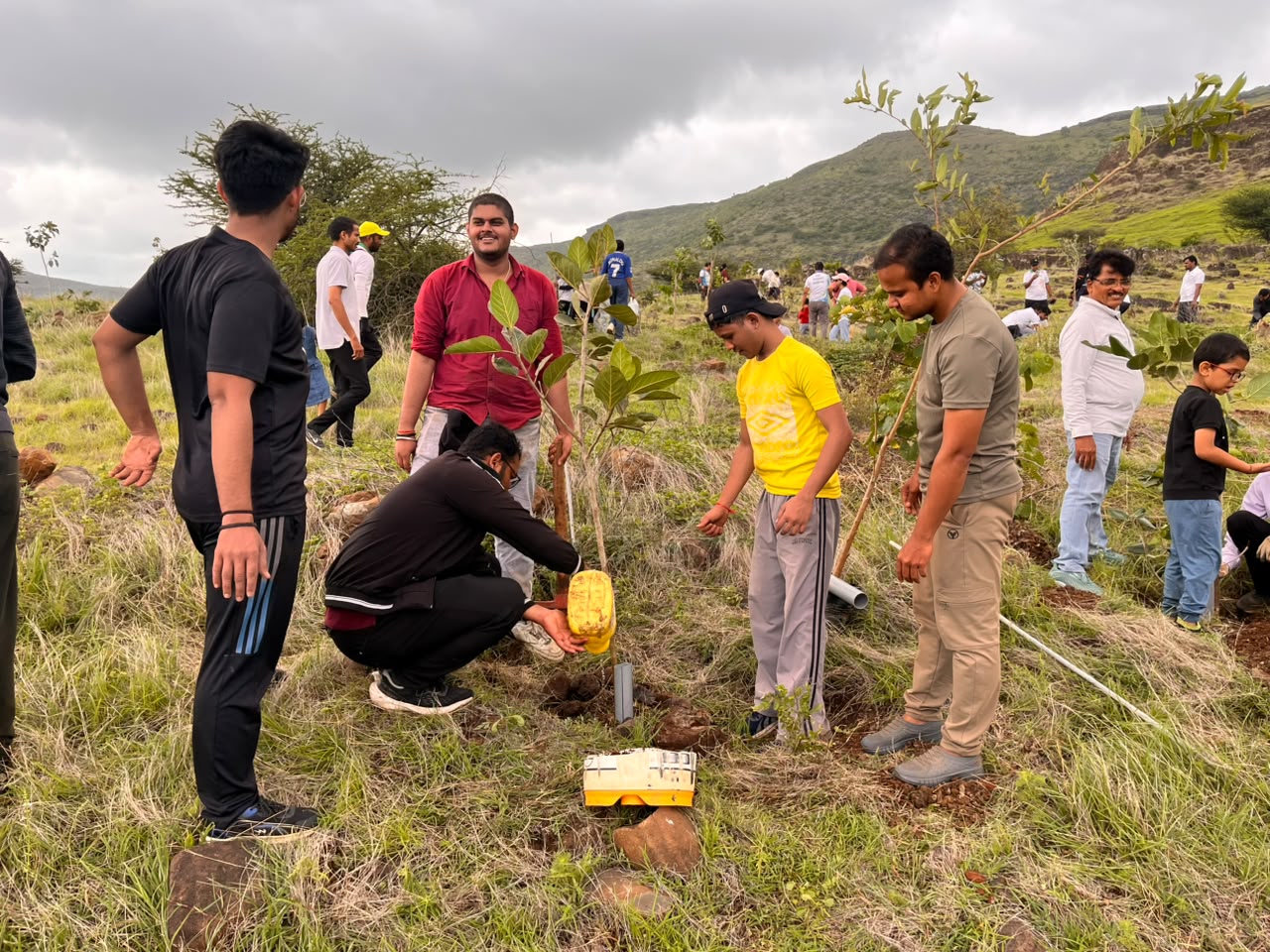
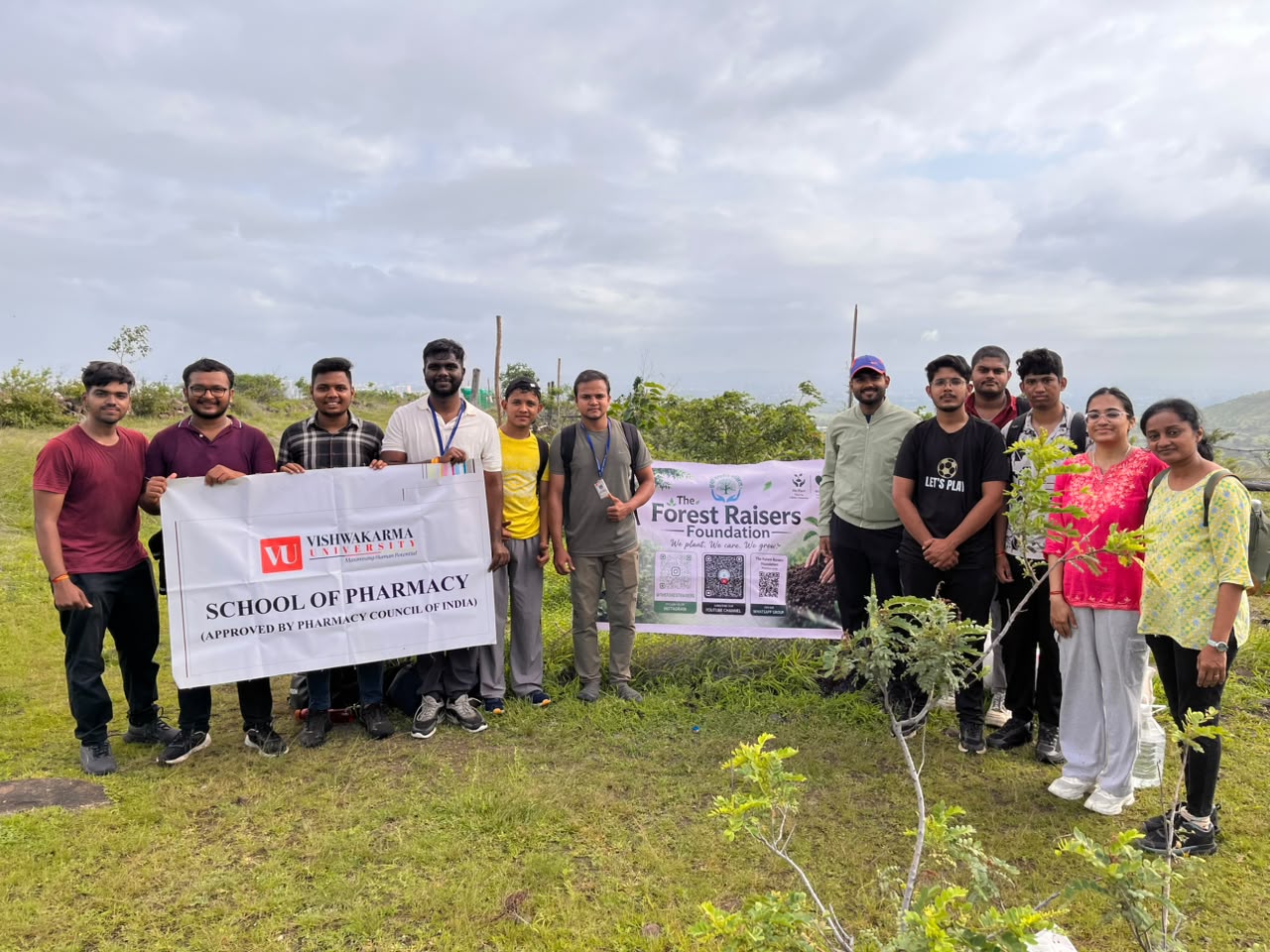
Report: To foster environmental stewardship and contribute to local ecological restoration, the School of Pharmacy at Vishwakarma University organized a Tree Plantation Drive at Diveghat in collaboration with The Forest Raisers Foundation, an organization dedicated to reforestation and afforestation. The initiative aimed to combat soil erosion, enhance green
cover, and boost biodiversity along the Diveghat slope. The volunteers from The Forest Raisers Foundation provided hands-on guidance regarding sapling alignment, soil preparation, and eco-friendly planting techniques suited for the rocky terrain of Diveghat.Students and faculty members collectively planted indigenous tree saplings chosen specifically for their high survival rate and ecological suitability to the local soil. The drive successfully combined hands-on environmental action with social responsibility. Beyond increasing local foliage, the event served as an experiential learning platform for pharmacy
students, highlighting the crucial connection between environmental health, biodiversity, and community well-being. The collaboration underscored Vishwakarma University’s commitment to sustainable development goals (SDGs) 11, 13 & 15 and community-driven ecological conservation.

NAVIGATION
QUICK LINKS
PROGRAMMES
CONTACT US
Only for Students
+91 9590300911Only for Faculties
+91 8669908316Copyright © Vishwakarma University, Pune 2026 All rights reserved..
[Best viewed in IE 10+, Firefox, Chrome, Safari, Opera.]
Powered by