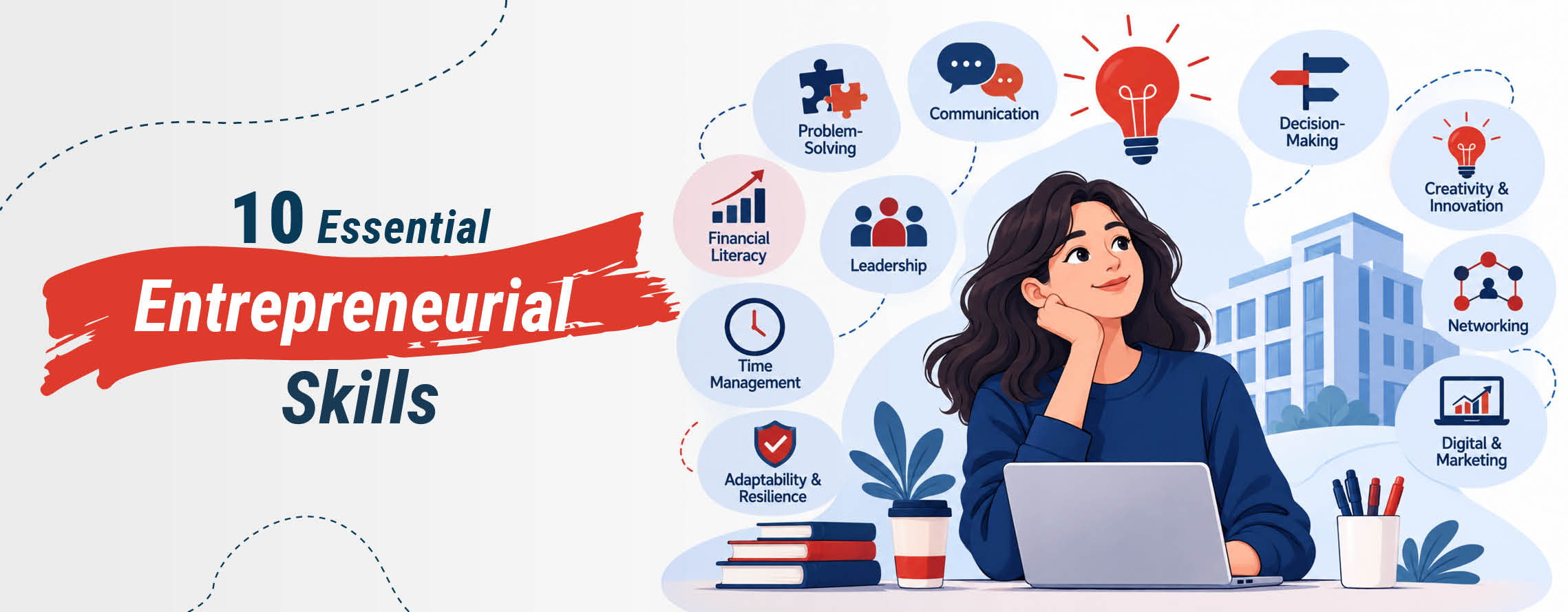
10 Essential Entrepreneurial Skills for College Students
Here are 10 important entrepreneurial skills that will help you grow as a student and professional.
-
Problem Solving
Every business starts with a problem worth solving. Entrepreneurs don’t just notice what’s wrong around them; they ask why it happens and what could be done differently. This habit trains you to think clearly, break big challenges into smaller parts and find practical solutions instead of waiting for someone else to fix things. Whether it’s a gap in a local market or an everyday issue on campus, the ability to spot and solve problems is what turns ideas into opportunities.
How to build it:
- Work through case studies and projects based on real-life problems.
- Pick a small problem on campus and try to come up with three possible solutions.
- Take part in hackathons and problem-solving challenges.
-
Communication
A great idea means little if you can’t explain it well. Entrepreneurs constantly communicate with investors, customers, team members and partners, and each audience needs a different approach. Good communication helps you present your proposals with confidence, listen to feedback and build strong professional relationships. It also covers writing clearly, from emails to business plans.
How to build it:
- Practise giving presentations and taking part in group discussions.
- Pitch your business ideas to friends or faculty and ask for honest feedback.
- Join debate clubs, public speaking groups or student committees.
-
Financial Literacy
Many promising ventures fail not because of a bad idea but because of poor money management. Understanding budgets, expenses, income, profit and cash flow helps entrepreneurs make smarter financial decisions and plan for growth. Even basic financial knowledge can help you price a product, manage costs and avoid unnecessary risks.
How to build it:
- Create a budget for a college event or project and track every expense.
- Learn the basics of profit and loss, pricing and break-even points.
- Manage your personal monthly expenses with a simple spreadsheet or app.
-
Leadership
Leadership is not just about being in charge. It’s about taking responsibility, motivating people and guiding a team towards a shared goal. Entrepreneurs often lead small teams in the early stages, so they need to delegate tasks, resolve conflicts and keep everyone focused, even when things get difficult. Good leaders also know when to listen and learn from their team.
How to build it:
- Lead a college event, fest committee or student club.
- Take charge of a group project and coordinate roles and deadlines.
- Volunteer for responsibilities that push you out of your comfort zone.
-
Time Management
Entrepreneurs juggle many roles at once: planning, selling, building and managing, often all in the same day. Without good time management, important tasks get lost in the rush. For students, learning to balance classes, assignments, projects and extracurriculars is excellent practice for the demands of running a business.
How to build it:
- Prioritise your tasks by urgency and importance.
- Create a weekly schedule and stick to set deadlines.
- Break large projects into smaller steps and finish them on time.
-
Decision-Making
Entrepreneurs make decisions every day, from small choices to ones that shape the future of their business. Good decision-making means gathering the right information, weighing the options, understanding possible risks and outcomes, and then acting with confidence. It also means accepting that not every decision will be perfect and learning from the ones that don’t work out.
How to build it:
- Take part in business simulations and decision-based activities.
- Before a big choice, list the pros, cons and possible outcomes.
- Reflect on past decisions to understand what worked and what didn’t.
-
Creativity and Innovation
Creativity means coming up with new ideas and innovation is about taking those ideas and making something useful from them. Entrepreneurs think differently about common things which can help improve existing products, make processes simpler or create brand new products. In a competitive market having new ideas can help put your business ahead.
How to build it:
- Join design thinking workshops, innovation challenges and idea competitions.
- Keep an idea journal and note down problems and possible solutions you come across.
- Collaborate with students from different disciplines to see problems from new angles.
-
Adaptability and Resilience
Business environments are constantly changing. Markets, technologies and strategies can change unpredictably. Entrepreneurs must be able to adapt to new situations, take on board feedback and push forward despite setbacks. They will be resilient so that they see failure as a learning opportunity and flexible to find a better way forward.
How to build it:
- Explore new technologies and tools, even outside your field of study.
- Ask for feedback on your work and use it to improve.
- Approach challenges with an open mind and reflect on what each setback taught you.
-
Networking
The right connections can open doors to mentorship, partnerships, funding and new opportunities. Networking is about building genuine relationships with mentors, industry professionals, alumni and fellow students, not just collecting contacts. A strong network gives you support, advice and collaboration when you need it most.
How to build it:
- Attend industry events, seminars, guest lectures and networking sessions.
- Connect with alumni and professionals on LinkedIn and engage with their work.
- Join student clubs and communities that share your interests.
-
Digital Marketing
Today, most customers discover products and services online. Understanding digital platforms, customer behaviour and marketing strategies helps entrepreneurs promote their ideas, build a brand and reach the right audience. Even a basic knowledge of social media, content and market research can make a big difference when you’re starting out with a limited budget.
How to build it:
- Learn the basics of social media marketing and content creation.
- Promote a college event, club or personal project online and track the results.
- Practise basic market research by surveying potential customers about an idea.
How to Develop Entrepreneurial Skills While Studying
Students can start building business skills for college students without launching a business. A few practical activities can help:
- Participate in competitions: Explore business plan competitions, hackathons and innovation challenges.
- Work on projects: Identify everyday problems and develop possible solutions.
- Attend workshops: Learn from entrepreneurs and industry professionals.
- Take leadership roles: Organise college activities and manage student initiatives.
- Explore online learning: Use the Startup India Learning Program to understand business planning and startup fundamentals.
- Build professional connections: Interact with mentors, alumni and fellow students.
These experiences help students understand how ideas are planned, developed and implemented.
National Entrepreneurs' Day 2026: Why Students Should Start Building These Skills Now
National Entrepreneurs' Day recognises the contributions of entrepreneurs in developing businesses, creating employment and introducing new ideas.
For students, the occasion highlights the importance of developing an entrepreneurial mindset early. Learning to identify opportunities, take calculated risks and turn ideas into practical solutions can help prepare them for future business and career opportunities.
How Vishwakarma University Helps Students Build Entrepreneurial Skills
At Vishwakarma University, students can explore opportunities to develop their ideas through the Vishwakarma University Innovation and Entrepreneurship Centre (VU-IQube).
The centre supports innovation and entrepreneurship through:
- Pre-incubation: Ideation, idea validation, mentorship and workshops.
- Incubation support: Strategic guidance, infrastructure and networking opportunities.
- IPR assistance: Support with patent filing, copyrights and trademarks.
- Entrepreneurship development: Workshops, training and capacity-building programmes.
VU also encourages student participation through its Start-up and Innovation Club, which focuses on developing ideas to solve modern problems.
Through initiatives such as student innovation programmes, Vishwakarma University provides opportunities for students to explore innovation, understand entrepreneurship and work towards developing their ideas.
Frequently Asked Questions
1. What are the five most important entrepreneurial skills?
Problem-solving, communication, financial literacy, leadership and decision-making are five important skills that help individuals explore entrepreneurial opportunities.
2. Can college students develop entrepreneurial skills without starting a business?
Yes. Students can develop these abilities through college projects, internships, competitions, workshops and leadership activities.
3. Why should students learn entrepreneurship skills?
Entrepreneurship skills help students become independent thinkers, identify opportunities, manage challenges and prepare for professional responsibilities.
4. How can I become an entrepreneur as a student?
Start by identifying a problem, researching possible solutions and developing a small business idea. Participate in entrepreneurship programmes and seek guidance from mentors to understand the process.