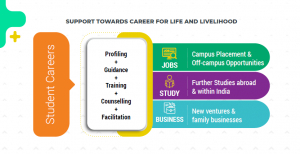
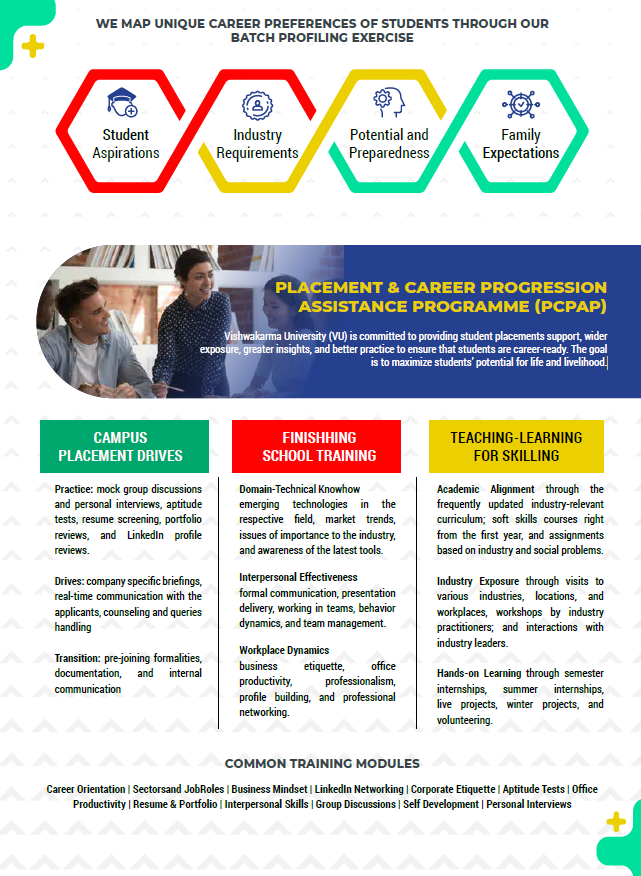
Vishwakarma University (VU) is committed to providing student placements support, wider exposure, greater insights, and better practice to ensure that students are career-ready. The goal is to maximize students’ potential for life and livelihood.
Value Added Career Oriented Tracks are open to all undergraduate students in VU from the Academic year 2024-25. Tracks: Global Experiential Learning | Industry Attachment | Research and Innovation | Academic Progression | Entrepreneurship | Community Engagement | Government and Public Sector

Overview : The ARC Workshop, spanning three days from April 26th to April 28th, 2024, provided participants with a comprehensive exploration of Linux, ROS (Robot Operating System), basic electronics, microcontrollers, and practical applications.
Day 1 initiated with fundamental Linux concepts, progressing to ROS fundamentals, and advanced Linux commands. Participants engaged in hands-on activities like VM installation and Ubuntu setup, enhancing their practical skills.
Day 2 introduced basic electronics and microcontrollers, comparing Arduino Uno and ESP, and conducting a practical traffic signal activity. This day provided insights into electronic components and their applications.
Day 3 focused on testing participants understanding of Linux and ROS principles and conducting practical activities such as distance measurement with ultrasonic sensors, motion detection with servo motors, and controlling doors using microcontrollers. These activities enabled participants to apply their knowledge to real-world scenarios.
Overall, the workshop fostered a blend of theoretical understanding and practical skills, equipping participants with valuable knowledge in Linux, ROS, basic electronics, and microcontrollers.

Workflow
Day1: Friday, April 26, 2024:
1. Introduction to Linux
2. Types of Linux
3. Practical Activity: VM installation; UBUNTU setup
4. ROS: Robot Operating System
5. ROS overview
6. Basics of ROS
7. Linux Basic Commands
8. Advance commands in Linux
9. Q&A Session
Day2: Saturday, April 27, 2024:
1. Introduction to Basic Electronics.
2. Introduction to Arduino
3. Arduino vs. ESP 32
4. Introduction to Kit
5. Practical activity: Traffic Signal; Slightly advanced version of
led blinking but with time intervals just like traffic signals we
see in daily life.
6. Q&A Session.
Day3: Sunday, April 28, 2024:
1. Test on the Previous two day (Linux, ROS and RaspberryPI)
2. Practical activity: Ultrasonic distance measuring; interfacing
ultrasonic sensor with led and buzzer
3. Practical activity: Motion detection by using ultrasonic sensor
and servo motor on Arduino UNO.
4. Practical Applications: Controlling Doors Using Servo Motor This
assignment will give us an idea of how to control the devices
using microcontrollers and a glimpse of the CNC machine
working with them.
5. Q&A Session
DAY 1
Introduction to Linux:
Covered the basics of what Linux is, its history, and its significance in the world of computing. Explained concepts like open-source software, different distributions, and the philosophy behind Linux.
Types of Linux:
Explored the different distributions available, discussing their target audiences, strengths, and weaknesses. Discussed common distributions like Ubuntu, Fedora, Debian, CentOS, and Arch Linux.
Practical Activity: VM Installation; Ubuntu Setup:
Conducted a hands-on activity where participants set up a virtual machine on their computers and installed the Ubuntu Linux distribution. This activity helped participants become familiar with the installation process and basic configuration of a Linux system.
ROS: Robot Operating System:
Introduced participants to ROS, explaining its architecture and various components. Discussed how ROS is used for writing software for robots in research and industrial applications.
Basics of ROS:
Delved into the fundamentals of ROS, covering topics such as nodes, topics, messages, services, and actions. Taught participants how to create simple ROS nodes and communicate between them using topics and messages.
Linux Basic Commands:
Taught essential command-line operations in Linux, such as navigating the file system, creating and manipulating files and directories, managing users and permissions, and performing basic system administration tasks.
Advanced Commands in Linux:
Covered more advanced command-line operations and techniques, including shell scripting, text processing tools like grep and awk, package management, and networking commands.
Q&A Session:

Day 2
(Introduction to basic electronics)
Introduction to Basic Electronics and Microcontrollers:
Briefly explained the fundamental concepts of electronics, such as circuits, components and how electricity flows.
Introduced microcontrollers; highlighting their importance in modern electronics and IoT (Internet of Things) applications.
Arduino Uno vs. ESP:
Describe what Arduino Uno is, its features, and its typical applications.
Differentiate between Arduino Uno and ESP, focusing on key differences like processing power, connectivity options (Wi-Fi, Bluetooth), and suitability for different projects.
Introduction to Hardware Kit:
List and describe the components included in the hardware kit provided to the students. Which included: Arduino Uno, Breadboard, ultrasonic sensors, LED’s, Resistors, Wires, Battery and many more.
Practical Activity: Traffic Lights with Arduino Uno and Breadboard:
Provide a detailed step-by-step explanation of the practical activity conducted during the workshop.
Explain the Arduino code used to control the traffic lights sequence.
Trying different sequences
Discuss any challenges faced during the activity

Day 3
(Test and Practical activities and applications)
Conducted a test on basic principles of Linux and ROS
Practical Activity 1: Distance Measurement with Ultrasonic Sensors:
Describe the practical activity involving distance measurement using ultrasonic sensors.
Outline the setup of the circuit on the breadboard, including connections to the Arduino Uno.
Practical activity 2: Enhanced Distance Measurement with Buzzer:
Detail the modification made to the previous circuit by adding a buzzer to indicate when the distance measured is too close.
Explain the logic behind activating the buzzer based on predefined distance thresholds.
Practical Activity 3: Servo Motor Control
Describe the practical activity focused on controlling servo motors.
Explain the concept of servo motors and their applications in robotics, automation, and control systems.
Provide instructions for wiring the servo motor to the Arduino Uno or ESP board and writing code to control its movement.
Radar Detection using Servo and Ultrasonic Sensors:
Detail the advanced activity involving radar detection using servo and ultrasonic sensors.
Describe the setup of the circuit, including the arrangement of the servo motor and ultrasonic sensor to simulate a radar system.
Acknowledgements:
Faculty coordinator: Maya Kurulekar
Student coordinator: Yash Kulkarni
Teaching resource:
|
Names |
Current Year |
Resource |
|
Pranav dagay |
Third year |
Hardware |
|
Bhavin Bhaldota |
Third Year |
Linux |
|
Pratham jain |
Third year |
Linux |
|
Aryan mehta |
Third Year |
Linux |
|
Aditya chavan |
Third Year |
Linux |
|
Saumya shah |
Third year |
Linux |
|
Samarth ratnaparkhi |
First year |
Hardware |
|
Anuj yadav |
First Year |
Hardware |
|
Vedant Pandhare |
First Year |
Hardware |
|
Anshul Patil |
First Year |
Hardware |
|
Abhijeet Karji |
First year |
Hardware |
Vendors:
Spark innovation
Address: S.No.59/2/44,Happy Home Hostel, next to Balaji Food Trader, Pune, Maharashtra 411048
Email: //This email address is being protected from spambots. You need JavaScript enabled to view it.">This email address is being protected from spambots. You need JavaScript enabled to view it.
Website: https://sparkinnovation.co.in/
Vishwakarma University
Organized by: Water Quality Centre of Excellence and Department of Engineering Science in collaboration with WILO
Theme: Harbouring Hope, Conserving Water: Smart Peace Iniaves
Introduction:
World Water Day, which falls on March 22nd, the student body, faculty, and staff came together to organize a series of events aimed at raising awareness about water sustainability and conservation. The events were designed to engage parcipants creatively while emphasizing the importance of water conservation in our daily lives.

Objective:
The objective of the World Water Day event at Vishwakarma University was to raise awareness about the critical importance of water conservation and sustainability. Through a series of engaging activities and competitions, the event aimed to inspire parcipants to think innovatively about water conservation strategies and to foster a sense of responsibility towards the preservation of this vital resource. By bringing together students, faculty, and staff, the event sought to cultivate a community-driven approach to addressing water-related challenges and promoting smart peace initiatives centered around water conservation.

About the Chief Guest:
Rtn. Ravindra Ulangwar, a Bachelor in Mechanical Engineering and MBA in Marketing Management from Symbiosis Institute of Management, is a Full bright Scholar with 33 years of experience in water management. Currently Vice President and Head of Water Management at Wilo Mather and Platt Pumps, he previously served as Director at Saisanket. Note worthy achievements include leading projects such as the SURASHTRA Branch Canal Pumping station, benefiting millions in Gujarat through drinking water and irrigation. His focus on innovative concepts like precision irrigation through Piped Distribution Networks showcases his commitment to advancing water management technologies.
Inaugration:
The event commenced with a session led by Mr. Ravi Ulangwar, during which he emphasized the significance of water across all aspects of our lives and underscored the critical importance of water conservation. He delved into a discussion on diverse approaches to water conservation and drew parallels between these methods and the work undertaken by engineers.

Competitions:
Following the enlightening session, numerous competitions were organized to facilitate student participation and engagement. The core aim of these events was to simulate active involvement among students and cultivate a more profound appretiation for the significance of water conservation. By participating in creative activies, attendees were encouraged to think carefully about how their actions that affect water and to come up with creative solutions to water-related problems.
Competitions Details:
The competitions were diverse, catering to various interests and talents of the participants. They included:
1. Ideathon: (30 parcipants)
- Parcipants were tasked with presenting their ideas on World Water Day using either a cardboard model or a PowerPoint presentation.
- Each team comprised four members, and the total duration of the event was three hours.
2. Water Themed Refreshments without Fuel: (49 parcipants)
- Parcipants showcased their culinary skills by preparing dishes in the form of water droplets or marine life without the use of fuel.
- Teams of four collaborated to create innovative and visually appealing refreshments within a one-hour time frame.
3. Animated Video Competition: (23 participants)
- Parcipants demonstrated their creativity by creating animated videos related to World Water Day.
- Teams consisting of five members had three hours to conceptualize, create, and edit their videos.
4. Partum I Orbis: (26 participants)
- A competition focused on providing sustainable solutions for water conservation in urban areas.
- Teams of five were challenged to devise innovate strategies within a two-hour time frame, emphasizing the crucial role of water in environmental sustainability.
The events received overwhelming participation from students across various disciplines, reflecting a strong commitment to environmental conservation within the student community. Through their participation, students gained valuable insights into the significance of water sustainability and its implications for a sustainable future.

Prize Distribution and Closing Ceremony:
The Prize Distribution and Closing Ceremony at Vishwakarma University marked the culmination of the successful World Water Day event. Winners, both 1st and 2nd place, were announced and celebrated for their remarkable contributions to water conservation awareness. Amidst an atmosphere of excitement, participants received recognition for their efforts, fostering a sense of camaraderie and encouragement. As prizes were awarded, attendees left with a renewed commitment to advocate for water sustainability in their communities.

Conclusion:
In conclusion, the World Water Day event at Vishwakarma University was a resounding success, uniting students, faculty, and staff in raising awareness about water sustainability. From Mr. Ravi Ulangwar's enlightening session to engaging competitions, parcipants demonstrated a deep commitment to addressing water challenges.
We extend heartfelt gratitude to volunteers, faculty, and student organizers whose relentless efforts ensured the event's success. Special thanks to our esteemed chief guest and dignitaries for enriching our discussions. Together, we reaffirm our commitment to advocating for a more sustainable future for our water resources.