So, haven't you graduated already?
This is the kind of question many students wonder about since universities tend to use both terms graduation and convocation as a single event. However, understanding convocation vs graduation can help you know when your degree is officially completed, what happens during the ceremony and why the occasion matters.
What Is Graduation?
Graduation is the successful completion of an academic programme after fulfilling the requirements set by a university or educational institution. Think of it as the moment when all those semesters of lectures, assignments, practicals, presentations and examinations finally add up to something. Whether you're pursuing a bachelor's degree, a master's degree or another academic qualification, graduation marks the completion of a particular stage of education.
However, completing your last examination doesn't automatically mean you've graduated. Your university must first confirm that you've met the academic requirements for the award of your qualification.
For example, imagine you've completed your final semester in May. Your results are announced in June, and the university confirms that you've successfully fulfilled all the programme requirements. You may then be recognised as a graduate, even if the convocation ceremony takes place several months later.
Simply put: graduation is about completing your education, not necessarily attending a ceremony.
What Is a Convocation Ceremony?
Now, imagine returning to your university a few months after your final examinations. You're dressed for the occasion, your parents are clicking pictures finding the best angle of your batch, and familiar faces from your batch are gathering in one place again.
This sounds like the story of a convocation day!
A convocation ceremony is a formal university-level event where eligible students are acknowledged for their academic excellence and degrees are either awarded or presented to them according to the university's regulations. The word convocation literally means a gathering of people for a certain task.
In the context of Indian universities, it usually refers to the ceremony conducted for the formal award or presentation of degrees. The convocation ceremony consists of an academic procession, speeches by the vice-chancellor and other esteemed guests, and the presentation of degrees to the successful graduates.
While graduation marks the end of a student's academic course, completing all requirements for the degree, a convocation gives the student a chance to share this achievement with the rest of the university.
Convocation vs Graduation: What's the Actual Difference?
The easiest way to understand the difference between convocation and graduation is to look at what each represents.
Graduation is an academic milestone. Convocation is a formal university occasion associated with recognising or conferring that achievement.
|
Basis |
Graduation |
Convocation |
|
Meaning |
Successful completion of an academic programme |
Formal academic ceremony or gathering |
|
Main purpose |
Recognising completion of academic requirements |
Conferring or celebrating academic achievements |
|
When it happens |
After the university confirms academic eligibility |
On a date scheduled by the university |
|
Ceremony required? |
Not necessarily |
The ceremony itself is the occasion |
|
Who is involved? |
Primarily the graduating student and institution |
Graduates, university officials, faculty and invited guests |
|
Degree certificate |
Issued according to university procedures |
May be presented or distributed during the ceremony |
One important distinction is that universities do not all follow identical procedures. Some formally confer degrees during convocation, while others confirm or award qualifications through separate academic processes.
That is why students should always refer to their university's official examination and convocation notifications.
While graduation marks the end of a student's academic course, completing all requirements for the degree, a convocation gives the student a chance to share this achievement with the rest of the university.
What Happens at a University Convocation?
If you're attending your first university convocation, you may be wondering what actually happens after everyone takes their seats. Although the exact programme differs between institutions, most convocation ceremonies follow a formal sequence.
-
The Academic Procession
Most convocations open with a grand academic procession including the university's officials, faculty members and other esteemed guests. It is one of the many traditions that make a convocation such a special event.
-
Opening of the Ceremony
The convocation is formally opened in accordance with the university's academic traditions. This could range from an invocation, university anthem, address by the Vice-Chancellor, amongst other formalities.
-
Conferral of Degrees
Perhaps the most anticipated aspect of a degree convocation is the conferral of degrees. Depending on the university's particular procedure, graduates may either collect their certificates on stage, separately or in some other manner.
-
Recognition of Academic Excellence
In addition to receiving their qualifications, many universities acknowledge students with an outstanding academic record with gold medals, merit awards and other accolades. It is a befitting end to years of hard work and dedication to one's studies.
-
The Convocation Address
Many universities invite a distinguished guest speaker to deliver a special address to the graduating batch. Unlike most commencement speeches, convocation addresses usually revolve around the opportunities and challenges that lie ahead after university.
-
Closing of the Ceremony
The convocation is formally closed with the appropriate readings and speeches. A convocation is not complete without pictures and celebrations with family, friends and teachers.
Why Is Convocation Day Important for Students?
You might wonder why universities organise such elaborate ceremonies when students have already spent years proving their academic abilities. It is a symbol that signifies the recognition of students’ efforts.
Opportunity to Reflect on Past Experiences
It is not always easy while studying at the university, as loads of coursework, complex subjects, group assignments, peer pressure, and deadlines force students to experience stress and question their decision to undertake their education.
Moreover, sometimes it may seem that all those challenges are not worth it, while the results of the studies are uncertain. Therefore, convocation creates opportunities for reflection and appreciation of the achievements.
Celebration of Success with Family and Educators
While talking about success, it shall also be noted that convocation is a great event for both students and their families. On the one hand, it is a personal achievement of the graduate, but on the other hand, it unites the family and the educational institution.
Hence, it unites the people who supported the student throughout the years of the studies and contributed to the final success. Consequently, it is a great honor for families to participate in the event.
The Opportunity to Become Part of Something Bigger
It shall also be mentioned that graduation is not the end of the road but the beginning of a new chapter in a graduate’s life.
The convocation event unites people who have different backgrounds but are part of the same university. Therefore, such students can keep in touch with their classmates, interact with teachers for future opportunities, find mentors among the faculty, and participate in various programs for graduates. Thus, convocation can also be considered an opportunity for students to become part of something bigger.
Graduation vs Convocation Ceremony in India: What Should Students Know?
In India, convocation is an important academic tradition followed by many universities. However, the process of obtaining a degree certificate can differ between institutions.
Here are a few practical things to remember.
- Completing your examinations is only one part of graduation. Your university must confirm that you've fulfilled the necessary academic requirements.
- Your final results and convocation may fall on different dates. It's common for universities to organise their ceremonies after students have completed their programmes.
- Degree certificates and provisional certificates serve different purposes. A provisional certificate may be issued before the final degree certificate becomes available, subject to university rules.
- Convocation registration may be required. Some universities ask eligible graduates to complete an application, confirm attendance or fulfil other formalities.
- Missing the ceremony does not necessarily mean losing your degree. However, the arrangements for conferral and collection of certificates depend on institutional regulations.
The best approach is to follow official university communications rather than relying on assumptions about how the process works.
Convocation at Vishwakarma University, Pune
At Vishwakarma University, Pune, convocation provides an occasion to recognise the academic journeys of students across its programmes.
It brings together graduates and members of the university community to acknowledge achievements and mark an important transition in students' lives.
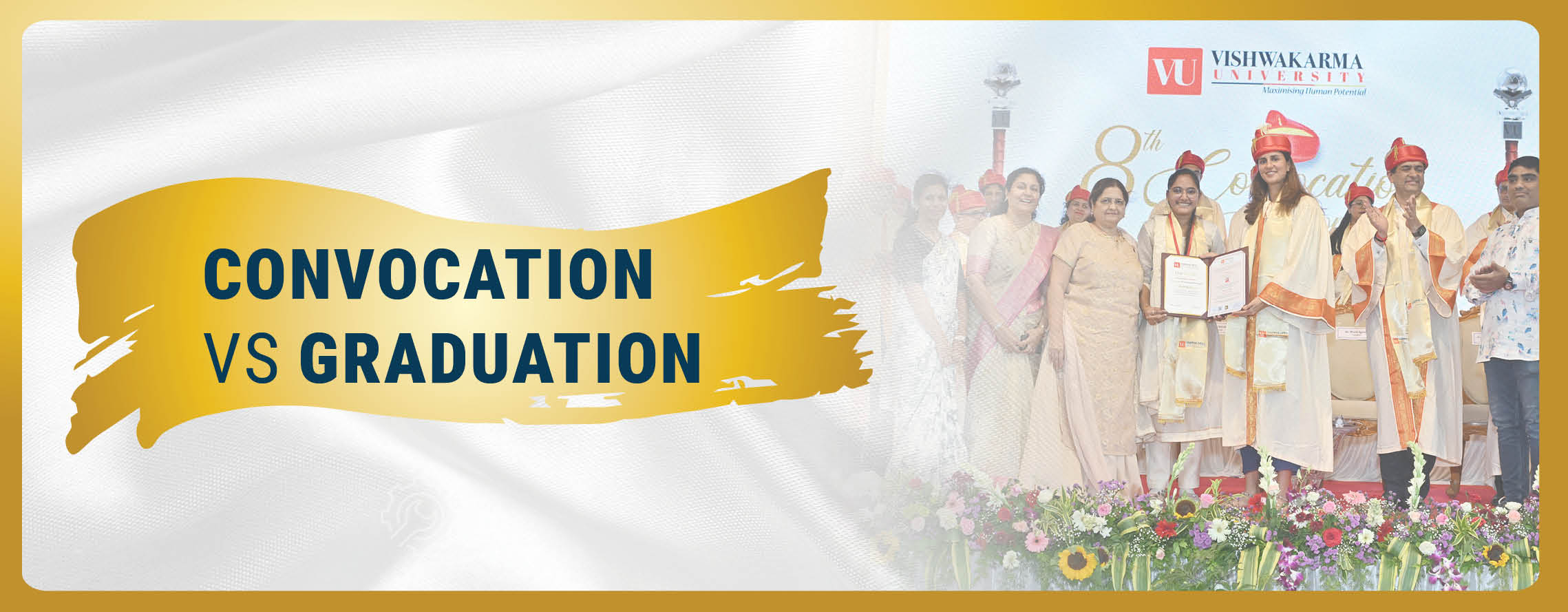
The university's 8th Convocation Ceremony, held on 9th October 2026, marked another occasion in this academic tradition.
Students and graduates looking for official convocation information, announcements and related notices can visit the Vishwakarma University Convocation Page.
Final Thoughts
Graduation and convocation may be connected, but understanding the distinction makes their significance clearer.
Graduation acknowledges what you've completed. Convocation gives that achievement a formal occasion of recognition.
One marks the successful completion of your academic journey. The other allows you to share that milestone with the people and university community who have been part of it. And years later, while you may not remember every examination or assignment, you'll probably remember what it felt like to reach the end of that chapter and realise how far you'd come.
Frequently Asked Questions About Convocation and Graduation
1. Is convocation the same as graduation?
Not exactly. Graduation refers to successfully completing an academic programme, while convocation is a formal university ceremony associated with conferring or celebrating academic achievements. The two are related, but they serve different purposes.
2. Can I graduate without attending convocation?
In many universities, yes. Students may complete the academic requirements for graduation without attending the ceremony. However, degree conferral procedures, certificate collection and participation requirements vary by institution.
3. What is the meaning of convocation for students?
For students, convocation is a formal recognition of academic achievement. It provides an opportunity to celebrate the completion of their studies and acknowledge the people and experiences that contributed to their journey.
4. Do students receive their degrees on convocation day?
This depends on the university. Some institutions present degree certificates during the ceremony, while others arrange distribution separately or follow different procedures for collecting certificates.
5. What should students wear to a convocation ceremony?
Universities generally communicate a prescribed dress code for convocation. This may include formal clothing, traditional attire, academic robes or other approved dress, depending on institutional guidelines.
6. Is convocation only for undergraduate students?
No. Convocation ceremonies may include eligible undergraduate, postgraduate and doctoral graduates. The qualifications recognised and participation arrangements depend on the university.